
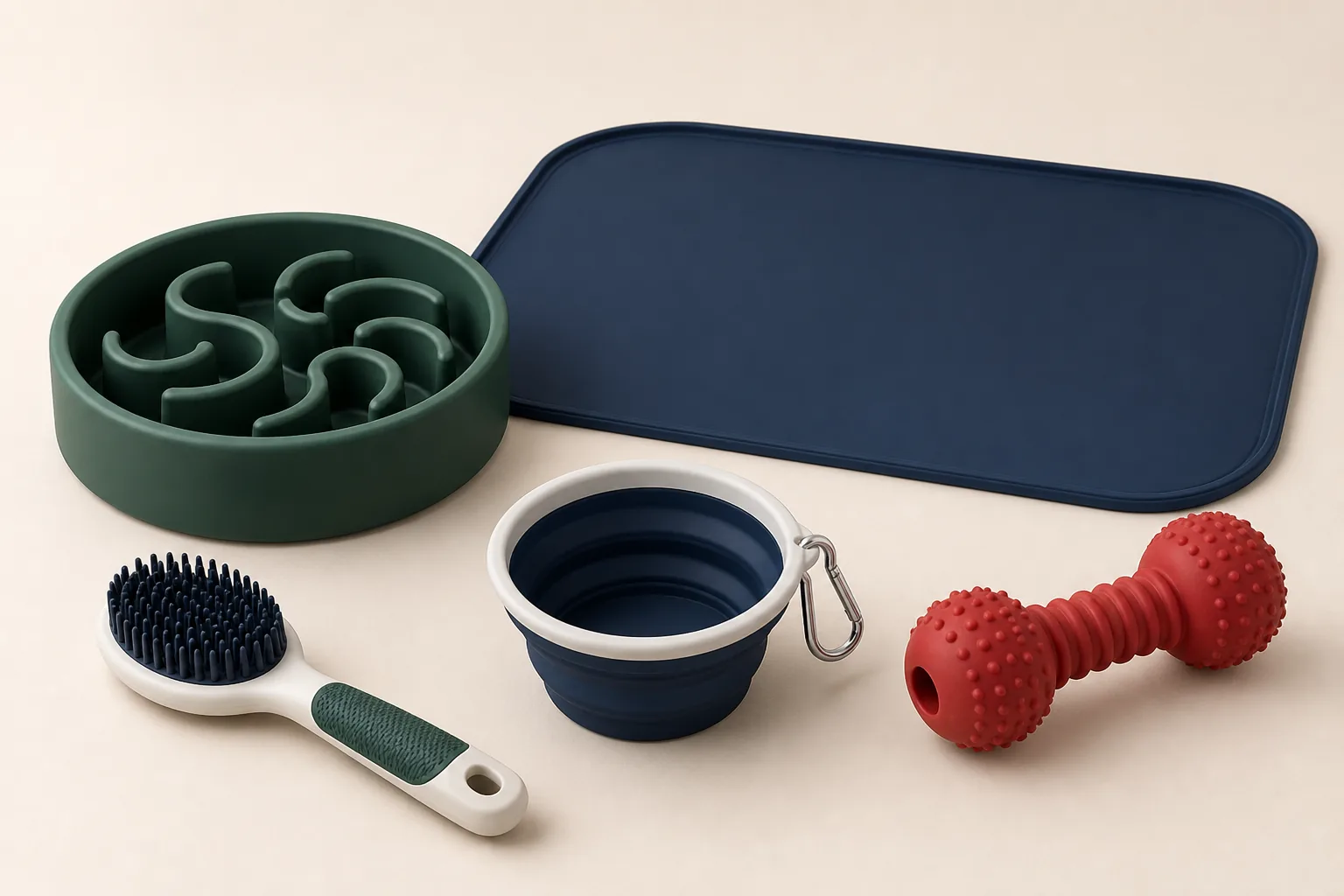
A sample can look ready for a range review while important approval questions remain open. The word “silicone” does not identify the compound used in a particular feeding mat, its processing history, or the checks completed on the finished item. Before approving a sample for tooling or a production reference, make the approval specific to an identifiable material, drawing and physical sample.
Define the job of this mat
Start with the intended market, where the mat will be used, the bowls or feeders it must accommodate, the expected contact with food and water, and how the customer is expected to clean it. Record any retailer or brand requirements alongside those conditions. If a requirement is still undecided, leave it open in the brief; a sample cannot answer a question that has not been specified.
For example, a mat intended to sit under two bowls needs an agreed layout and edge profile. The buyer should be able to compare the sample with those agreed details. A photograph alone is a poor approval record for dimensions, underside texture or how the mat sits with the actual bowls.
Identify the material and process proposed
Silicone rubber comes in different material and processing forms. WACKER distinguishes high-consistency rubber from liquid silicone rubber and discusses different curing routes; Dow likewise describes multiple silicone fabrication methods. These are general supplier references, not evidence that a particular MEGATECH product uses one of those routes. WACKER material and processing guide · Dow rubber fabrication overview
Ask the proposed supplier to identify the exact compound grade and provide the current technical document for that grade. Record the proposed molding and cure or post-cure route, including the basis for any decision not to post-cure. If colorants or other components are part of the proposal, identify them in the project record. A generic material description or a data sheet for a different grade does not close this item.
Review one traceable sample against one agreed brief
Use the fields below as a discussion worksheet. They are not a universal safety standard or a claim that any test has been passed.
| Approval field | What the buyer should record | What remains to be checked |
|---|---|---|
| Intended use | Market, bowls or feeder, contact conditions and cleaning method | Are the conditions specific enough to choose the checks? |
| Material | Exact grade, document revision and any colorant or component details | Does the physical sample use the proposed material? |
| Processing | Proposed molding, cure and any post-cure decision | What production record will connect the sample to this route? |
| Geometry | Approved drawing revision, dimensions, thickness, edge and underside details | Does the measured sample match the agreed tolerances? |
| Surface and cleaning | Target color, texture, finish and areas where residue could collect | Can the agreed cleaning method reach those areas? |
| Finished-part checks | Test scope, method, acceptance criteria and responsible approver for the target market | Which results are available, and which remain pending? |
| Approval record | Sample identifier, date, open issues and decision owner | Which exact revision can be used as the next-stage reference? |
A supplier material document helps identify and compare the proposed compound. It does not, by itself, measure the molded mat, validate its cleaning instructions or establish a finished-part result. Set the finished-item checks with the buyer and the appropriate testing party for the intended market and use. Request reports for the actual scope and representative sample; do not treat a proposed test as a passed one.
Freeze the decision, not just the photograph
After the review, record whether the sample is approved, approved subject to named changes, or still on hold. List each open issue with an owner and the evidence needed to close it. If the compound, color package, drawing, process or intended cleaning method changes, decide which checks must be repeated before using the earlier approval as a production reference.
Our silicone material guide gives broader material context. For a project discussion, bring the intended market, use conditions, drawing and sample questions above. Discuss a silicone feeding-product brief with MEGATECH. Ask for a proposed grade and a project-specific validation plan; do not assume one is already approved.